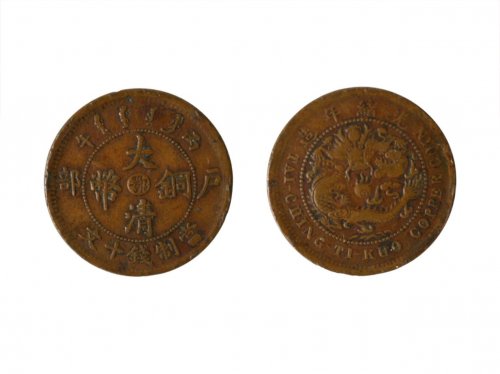
品类:古钱币
尺寸:直径28mm 厚度1.5mm 重:7.6g
学名:大清铜币
错版藏珍 铜光独耀——鄂字版大清铜币当制钱十文错版币精品推荐
在清末铜元收藏的江湖中,“稀缺”是价值的核心密码,而“错版”则是稀缺之上的“皇冠明珠”。有一枚钱币,既烙着湖广新政的工业印记,又携带着百年前造币车间的“无心之失”,它就是户部丙午鄂字版大清铜币当制钱十文错版币。这枚集“历史基因、工艺瑕疵、传世稀缺”于一身的货币遗珍,以独一无二的“错版标识”,成为藏家竞逐的顶级标的,在铜元收藏史上写下浓墨重彩的一笔。
一、错版溯源:新政洪流中的“无心之珍”
错版币的价值,始于“成因的合理性”与“发生的偶然性”,这枚鄂字错版铜元的诞生,与清末币制改革的特殊背景密不可分。1906年,清廷推行户部统币政策,湖北造币厂作为张之洞新政的“工业标杆”,承接了鄂字版大清铜币的铸行任务。彼时,造币厂引入德国克虏伯冲压设备,开启标准化生产,但机器调试的细微偏差、钢模雕刻的毫厘失误,或是冲压过程中的瞬间错位,都可能造就“错版”——而清末造币高峰期的“赶工压力”,更让这类“无心之失”成为不可复制的时代产物。
与现代“人为错版”不同,清末铜元错版完全源于手工与机器协作中的自然误差,且一旦发现便会立即销毁,极少流入市场。这枚鄂字错版币能突破“质检关卡”传世至今,堪称“天选之珍”。其错版类型(如复打、移位、漏印等),不仅是湖北造币厂生产流程的“活证据”,更折射出清末工业化转型中“标准与误差并存”的真实面貌,这份“带着瑕疵的历史感”,正是错版币最珍贵的灵魂所在。
二、错版解码:独一无二的“身份标识”
这枚鄂字错版币的核心价值,在于其“一眼可辨、不可复制”的错版特征。结合市场公认的稀缺错版类型,其典型标识主要体现在以下三类,每一种都堪称“上帝的笔触”:
1. 核心错版:错版二十度
背面大清龙纹侧移位约二十度,但龙、祥云的细节仍清晰完整。这是“主图案移位”的错版,在鄂字十文铜元中存世量极少,是错版收藏中的“顶级配置”。
2. 基底特征:延续精品的工艺基因
错版不代表粗制滥造,这枚错版币的“基底工艺”与官铸精品完全一致,印证其“正品错版”的身份:
材质:采用“九五紫铜”配比,铜质致密温润,上手沉实无虚浮感,百年传世形成的“深褐包浆”均匀覆盖币面,错版痕迹被包浆自然包裹,无人工改造的生硬感;
形制:严格遵循户部标准,直径28毫米,厚度1.5毫米,重量7.6克,虽龙纹移位,但整体钱体规整,外郭圆润无毛刺,平整干净;
细节:未错版区域工艺精湛——龙鳞以浅浮雕刻画,“丙午”纪年、“当制钱十文”面值清晰有力;币缘橄榄齿间距均匀。
2. 科研价值:造币工艺的“活标本”
错版币是研究清末造币工艺的“特殊样本”。通过分析其错版类型,可还原湖北造币厂的冲压流程——复打特征印证了当时“单次冲压不完全,二次补压”的应急生产模式;龙纹移位则揭示了币坯定位装置的细微缺陷。这些信息,是正史文献中未记载的“工业细节”,为研究张之洞湖广新政时期的工业技术水平,提供了无可替代的实物依据,其科研价值远超普通流通币。
3. 市场价值:持续攀升的投资标杆
错版币的市场价格,往往是同品相普通币的几十倍。错版币拼“唯一性”,而“唯一性”正是高端收藏市场最核心的定价锚点。
百年前的一次机器偏差,造就了今日的传世奇珍。这枚鄂字版大清铜币当制钱十文错版币,以“错版”为独特标识,用“精品工艺”为价值兜底,凭“稀缺存世”为增值护航。对于藏家而言,收藏它不仅是拥有一件“天价铜元”,更是守护一段“带着温度的工业历史”——那些看似的“瑕疵”,恰恰是时光赋予的最珍贵印记,使其在万千铜元中,绽放出独一无二的璀璨光芒。
Rare Treasure of Error Version, Unique Brilliance of Copper: Recommendation of the Exquisite Error – Version "E" – Marked Qing Dynasty Copper Coin (Worth Ten Cash) In the field of late Qing Dynasty copper coin collection, "scarcity" is the core code of value, and "error version" is the "crown jewel" beyond scarcity. There is a coin that not only bears the industrial mark of the Huguang New Deal but also carries the "unintentional mistake" of the mint workshop a hundred years ago. It is the error – version "E" – marked Qing Dynasty copper coin (worth ten cash) minted in the Bingwu year under the Ministry of Revenue. This precious remaining coin, which combines "historical genes, craftsmanship defects, and rare survival", has become a top target pursued by collectors with its unique "error – version mark", leaving a brilliant mark in the history of copper coin collection. ## I. Origin of the Error Version: An "Unintentional Treasure" in the Tide of the New Deal The value of an error – version coin originates from the "rationality of its cause" and the "randomness of its occurrence". The birth of this "E" – marked error – version copper coin is closely related to the special background of the currency system reform in the late Qing Dynasty. In 1906, the Qing court implemented the currency unification policy of the Ministry of Revenue. As the "industrial benchmark" of Zhang Zhidong's New Deal, the Hubei Mint undertook the task of minting the "E" – marked Qing Dynasty copper coins. At that time, the mint introduced German Krupp stamping equipment and started standardized production. However, slight deviations in machine debugging, tiny mistakes in steel mold carving, or momentary misalignment during the stamping process could all lead to the creation of an "error version". Moreover, the "rush work pressure" during the peak period of coin minting in the late Qing Dynasty made such "unintentional mistakes" become irreproducible products of the era. Different from the modern "man – made error versions", the error versions of copper coins in the late Qing Dynasty were completely caused by natural errors in the cooperation between manual work and machines. Once discovered, they would be immediately destroyed, and very few of them could flow into the market. The fact that this "E" – marked error – version coin could pass through the "quality inspection barrier" and be passed down to the present day can be called a "heaven – chosen treasure". Its error – version types (such as double striking, misalignment, missing printing, etc.) are not only "living evidence" of the production process of the Hubei Mint but also reflect the true situation of "coexistence of standards and errors" during the industrialization transformation in the late Qing Dynasty. This "historical sense with defects" is precisely the most precious soul of the error – version coin. ## II. Decoding the Error Version: A Unique "Identity Mark" The core value of this "E" – marked error – version coin lies in its "easily distinguishable at a glance and irreproducible" error – version characteristics. Combining the scarce error – version types recognized in the market, its typical marks are mainly reflected in the following three categories, each of which can be called "the stroke of God": ### 1. Core Error Version: 20 – Degree Misalignment The "Great Qing Dragon Pattern" on the reverse side is laterally misaligned by approximately 20 degrees, but the details of the dragon and the auspicious clouds are still clear and complete. This is an error version with "main pattern misalignment". The number of such coins in the "E" – marked ten – cash copper coins is extremely rare, making it a "top – tier configuration" in the collection of error – version coins. ###
2. Basic Characteristics: Inheriting the Craftsmanship Genes of Exquisite Products An error version does not mean shoddy work. The "basic craftsmanship" of this error – version coin is completely consistent with that of the exquisitely made official – minted coins, which confirms its identity as an "error – version of a genuine product": – **Material**: It adopts the "95% red copper" ratio. The copper is dense and smooth, giving a solid feel without a sense of flimsiness when held in the hand. The "dark brown patina" formed after a hundred years of inheritance evenly covers the surface of the coin. The error – version marks are naturally wrapped by the patina, without the stiff feeling of artificial modification. – **Shape and Size**: It strictly follows the standards of the Ministry of Revenue, with a diameter of 28 millimeters, a thickness of 1.5 millimeters, and a weight of 7.6 grams. Although the dragon pattern is misaligned, the overall coin body is neat, the outer edge is smooth and free of burrs, and the hole is flat and clean. – **Details**: The craftsmanship of the non – error – version areas is exquisite. The dragon scales are carved with low relief, and the "Bingwu" year mark and the "worth ten cash" denomination are clear and forceful. The spacing of the olive teeth on the coin edge is uniform. ###
3. Key to Authenticity: The "Irreproducibility" of Error – Version Characteristics Most of the counterfeit products in the market are "man – made carved error versions", which are essentially different from natural error versions. The double – striking marks of genuine products are natural, the double images are consistent with the main font, and the edge transition is smooth. In contrast, the counterfeits have "fake double images" carved manually, with stiff strokes that are disconnected from the original font. After the dragon pattern of the genuine product is misaligned, the muscle lines of the dragon's body and the direction of the mane still conform to the design logic of the original steel mold. However, the misaligned dragon pattern of the counterfeit often has problems such as disproportionate proportions and vague details. In addition, the patina in the error – version area of the genuine product is consistent with the overall patina of the coin surface, while the counterfeit has broken patina and uneven color in the error – version area due to later modification. ## III. Collection Value ###
2. Scientific Research Value: A "Living Specimen" of Coin – Minting Craftsmanship Error – version coins are "special samples" for studying the coin – minting craftsmanship in the late Qing Dynasty. By analyzing their error – version types, we can restore the stamping process of the Hubei Mint. The double – striking feature confirms the emergency production mode of "incomplete single stamping and secondary supplementary stamping" at that time, and the misalignment of the dragon pattern reveals the slight defects of the coin blank positioning device. This information is the "industrial details" not recorded in the official historical documents, and it provides an irreplaceable material basis for studying the industrial and technological level during the period of Zhang Zhidong's Huguang New Deal. Its scientific research value is far higher than that of ordinary circulating coins. ### 3. Market Value: A Continuously Rising Investment Benchmark The market price of error – version coins is usually ,times that of ordinary coins of the same quality. Error – version coins compete for "uniqueness", and "uniqueness" is precisely the core pricing anchor in the high – end collection market. A machine deviation a hundred years ago created this precious handed – down treasure today. This error – version "E" – marked Qing Dynasty copper coin (worth ten cash) takes the "error version" as its unique mark, relies on "exquisite craftsmanship" to underpin its value, and depends on "rare survival" to guarantee its appreciation. For collectors, collecting it is not only about owning an "expensive copper coin" but also about safeguarding a "piece of industrial history with warmth". Those seemingly "defects" are precisely the most precious marks endowed by time, making it shine with a unique and brilliant light among thousands of copper coins.