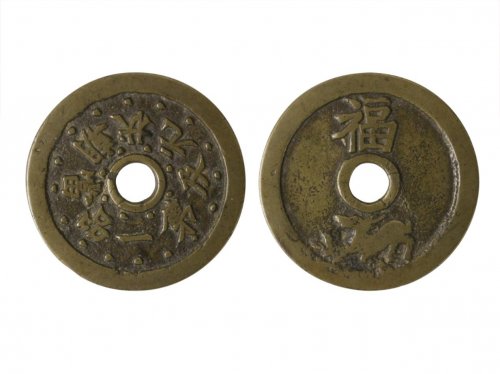
品类:古钱币
尺寸:直径45mm 厚度2.5mm 重:20.8g
学名:一品当朝状元及第花钱
吉语铸珍 前程入梦 —— 一品当朝状元及第花钱精品推荐
在古代花钱的收藏殿堂中,有一枚承载着千年科举理想与民俗祈愿的珍品,它以 “一品当朝” 的威仪、“状元及第” 的期许,将仕途荣光与吉祥寓意熔铸于方寸铜器之上,成为跨越时空的文化信物。这便是明清时期铸行的 **“一品当朝・状元及第” 吉语花钱 **—— 它非流通货币,却因深厚的文化内涵、精湛的工艺水准与稀缺的存世量,成为藏家追捧的 “吉庆重器”,更是中式收藏中兼具审美价值与精神寓意的典范。
一、历史溯源:科举文化催生的吉庆信物
花钱,又称 “厌胜钱”“压胜钱”,是古代民间用于祈福、辟邪、纪念的非流通钱币,而 “一品当朝・状元及第” 花钱的诞生,与中国千年科举制度深度绑定,是时代文化的直接映射。
自隋唐科举制创立以来,“金榜题名” 便成为古代文人墨客的终极追求,“状元” 作为科举殿试第一甲第一名,更是 “天下第一才子” 的象征,代表着仕途巅峰与家族荣光。到明清时期,科举制度达到鼎盛,社会对科举功名的追捧催生了各类祈福信物,“一品当朝・状元及第” 花钱应运而生。它既是文人赴考前的护身符,承载着 “一举夺魁” 的美好期许;也是长辈赠予晚辈的励志礼,寄托着 “青云直上” 的殷切祝福;更有达官贵人将其悬挂于厅堂、佩戴于身,彰显对仕途顺遂的向往与身份尊崇。
这枚花钱的铸行跨度贯穿明清两代,其中以清代中早期铸品最为精良 —— 彼时社会稳定,手工业发达,造币工艺成熟,加之科举文化深入人心,此类吉语花钱的铸造既注重寓意表达,又追求工艺完美,成为花钱收藏中的 “黄金时期” 产物。历经数百年流转,它不仅是科举制度的实物见证,更成为中式 “成功文化” 的精神图腾,承载着中国人对 “学有所成、功成名就” 的永恒向往。
二、工艺解析:方寸之间的吉庆美学
“一品当朝・状元及第” 花钱的珍贵,不仅在于其文化寓意,更在于其集书法、绘画、铸造工艺于一体的艺术价值,每一处细节都彰显着古代工匠的巧思与匠心:
1. 材质与形制:厚重温润的质感基底
真品多采用高纯度青铜或黄铜铸造,铜质致密温润,上手掂之有明显 “压手感”,历经百年氧化形成的自然包浆尤为动人 —— 浅黄带绿的 “古铜色”,包浆均匀细腻,轻抚之下能感知铜质本身的细腻肌理,无化学做旧的生硬感。
形制上多为圆形方孔(偶见圆形圆孔),遵循 “天圆地方” 的传统宇宙观,规格规整统一,钱体边缘圆润光滑,无毛刺棱角,方孔穿口平整干净,体现出严格的标准化铸造工艺,在民间花钱中实属精整之品。
2. 图文设计:双重吉庆的文化密码
花钱的图文设计堪称 “吉语 + 纹饰” 的完美融合,正面与背面分别承载核心寓意,形成双重祝福:
正面:吉语铿锵,直抒胸臆
核心文字 “一品当朝 状元及第” 以楷书或隶书镌刻,字体端庄遒劲,笔力刚健饱满。“一品当朝” 寓意官至极品、权倾朝野,“状元及第” 直指科举巅峰,八字吉语上下或左右排列,间距均匀,章法严谨,既具书法艺术的审美价值,又传递出直白强烈的祈福愿望。部分精品还在文字两侧辅以对称的卷草纹、回纹,线条流畅灵动,为庄重的吉语增添了灵动之美。
背面:神兽纹饰吉祥,暗藏深意
背面纹饰是花钱的 “灵魂所在”彰显文人雅士的才情与品格,呼应科举制度对学识的推崇。
无论何种纹饰,均采用浅浮雕或阴刻工艺,图案层次分明,立体感强 —— 神兽都刻画得栩栩如生,方寸之间尽显工匠的精湛技艺,堪称 “微缩的民俗艺术品”。
3. 工艺细节:匠心独运的防伪与质感
铸造工艺极具辨识度:钱文与纹饰边缘深峻清晰,无模糊粘连,字体笔画无断笔、缺笔现象;币缘“连珠纹”,排列整齐均匀,既是防止私铸的防伪设计,也提升了整体的装饰性;更显华贵典雅。
平整光滑,无砂眼、气泡等铸造瑕疵,这得益于当时先进的翻砂工艺与严格的质量把控,是民间私铸品无法企及的工艺高度。
三、收藏核心:三重价值铸就传世珍品
“一品当朝・状元及第” 花钱之所以能成为花钱收藏中的 “硬通货”,源于其历史价值、文化价值与市场价值的三重叠加,是兼具精神内涵与收藏潜力的优质标的:
1. 历史价值:科举制度的 “活化石”
作为明清科举文化的直接实物遗存,它见证了科举制度对社会文化、民间信仰的深远影响,是研究古代教育制度、民俗文化、社会心态的重要佐证。与冰冷的史书相比,这枚花钱更具 “烟火气”—— 它曾被文人贴身佩戴、被家族悉心珍藏,承载着普通人的功名梦想,这份 “有温度的历史” 使其成为不可复制的文化遗产。
2. 文化价值:中式祈福的精神图腾
在中国传统文化中,“状元及第” 代表着 “学业有成”,“一品当朝” 象征着 “事业巅峰”,二者结合的吉语,精准击中了中国人对 “成功” 的核心诉求。即便在科举制度早已消亡的今天,它所蕴含的 “勤学向善、追求卓越” 的精神内核依然具有强大的感染力,成为现代收藏中 “寓意吉祥” 类藏品的典范,兼具装饰价值与精神寄托意义。
3. 市场价值:稀缺精品的增值潜力
花钱的收藏价值与 “品相、版别、工艺” 直接挂钩:
版别上,清代中早期官铸精品(尤其是 “魁星点斗” 纹饰版)存世量极少,因铸造精良、寓意鲜明,市场认可度最高;
品相上,“钱文清晰、纹饰完整、包浆自然” 的全品存世量不足同类花钱的 10%,稀缺性上,民间私铸品虽较多,但官铸精品因铸造标准高、存世量少,长期处于 “供不应求” 的状态,加之近年来传统文化收藏热兴起,其价格稳步攀升,成为花钱收藏体系中的 “核心配置”。
对于藏家而言,收藏它不仅是拥有一件钱币珍品,更是守护一段中式文化记忆 —— 它所承载的 “学业有成、事业顺遂” 的美好期许,跨越时空依然能引发共鸣。在如今快节奏的生活中,一枚凝聚着千年智慧与祝福的花钱,既是书房中的雅致陈设,也是心灵上的精神寄托,其价值在时光沉淀中愈发璀璨。
Auspicious Words Cast in Treasure, Future Dreams in Copper — Recommendation of the Exquisite "Top Scholar in the Imperial Exam, First-Rank Official" Charms In the treasure hall of ancient Chinese charm collections, there is a precious piece that carries a thousand years of imperial examination ideals and folk aspirations. With the majesty of "First-Rank Official in the Imperial Court" and the expectation of "Top Scholar in the Imperial Exam", it forges the glory of official careers and auspicious meanings onto a small copper object, becoming a cultural token transcending time and space. This is the **"First-Rank Official in the Imperial Court · Top Scholar in the Imperial Exam" auspicious charm** minted during the Ming and Qing dynasties. Though not a circulating currency, it has become a "treasured auspicious artifact" sought after by collectors due to its profound cultural connotations, exquisite craftsmanship, and rare survival quantity. It is even a model in Chinese-style collections that combines aesthetic value with spiritual significance. ## I. Historical Origin: An Auspicious Token Born from the Imperial Examination Culture Charms, also known as "yansheng qian" (warding off evil money) or "yasheng qian" (suppressing evil money), are non-circulating coins used by ancient people for praying for blessings, warding off evil, and commemoration. The birth of the "First-Rank Official in the Imperial Court · Top Scholar in the Imperial Exam" charm is deeply tied to China’s thousand-year imperial examination system and is a direct reflection of the cultural context of its era. Since the establishment of the imperial examination system in the Sui and Tang dynasties, "achieving success in the imperial exam" (jinbang timing) has been the ultimate pursuit of ancient scholars. The "zhuangyuan" (top scholar), as the first-place winner of the highest level of the imperial exam (dianshi), is even a symbol of "the most talented person in the country", representing the pinnacle of an official career and the glory of a family. By the Ming and Qing dynasties, the imperial examination system reached its prime. The social pursuit of academic honors and official positions gave rise to various blessing tokens, and the "First-Rank Official in the Imperial Court · Top Scholar in the Imperial Exam" charm came into being. It served as an amulet for scholars before taking the exam, carrying the beautiful wish of "winning the first place in one go"; it was also an inspirational gift from elders to younger generations, embodying the sincere blessing of "rising rapidly in one’s career"; even high-ranking officials hung it in their halls or wore it on their persons to show their yearning for a smooth official career and their noble status. The minting of this charm spanned both the Ming and Qing dynasties, with the most exquisite pieces produced in the early to middle Qing Dynasty. During that period, social stability, advanced handicraft industry, and mature coin-making technology, combined with the deep-rooted influence of the imperial examination culture, ensured that the minting of such auspicious charms focused not only on expressing meanings but also on pursuing perfect craftsmanship. These pieces thus became products of the "golden age" of charm collections. After hundreds of years of circulation, the charm is not only a material witness to the imperial examination system but also a spiritual totem of Chinese-style "success culture", carrying the eternal Chinese aspiration for "achieving academic excellence and career success". ## II. Craftsmanship Analysis: Auspicious Aesthetics in a Small Space The value of the "First-Rank Official in the Imperial Court · Top Scholar in the Imperial Exam" charm lies not only in its cultural implications but also in its artistic value that integrates calligraphy, painting, and casting techniques. Every detail showcases the ingenuity and craftsmanship of ancient artisans: ###
1. Material and Shape: A Solid and Warm Textural Foundation Authentic pieces are mostly cast from high-purity bronze or brass. The copper is dense and warm, and when held in the hand, it has a distinct "weighty feel". The natural patina formed after a hundred years of oxidation is particularly appealing — it may take on a "jujube red" color (dark brown with a reddish tint) or an "ancient bronze color" (light yellow with a greenish hue). The patina is uniform and delicate; when gently touched, one can feel the fine texture of the copper itself, without the stiff texture of chemically aged fakes. In terms of shape, most are round with a square hole (round with a circular hole is rare), following the traditional Chinese cosmic concept of "heaven is round, earth is square". The specifications are neat and uniform: the edge of the charm is smooth and rounded, with no burrs or sharp corners, and the square hole is flat and clean. These features reflect strict standardized casting techniques, making it an exceptionally well-made piece among folk charms. ###
2. Design of Characters and Patterns: Cultural Codes of Double Blessings The design of the charm’s characters and patterns is a perfect combination of "auspicious words + decorative patterns". The obverse and reverse each carry core meanings, forming double blessings: #### Obverse: Resonant Auspicious Words, Straightforward Aspirations The core characters "First-Rank Official in the Imperial Court · Top Scholar in the Imperial Exam" are engraved in regular script or clerical script. The font is dignified and forceful, with sturdy and full strokes. "First-Rank Official in the Imperial Court" implies reaching the highest rank in the official hierarchy and holding great power; "Top Scholar in the Imperial Exam" directly refers to the pinnacle of the imperial examination. The eight-character auspicious phrase is arranged either vertically (top and bottom) or horizontally (left and right), with even spacing and rigorous composition. It not only has the aesthetic value of calligraphy art but also conveys a straightforward and strong wish for blessings. Some exquisite pieces are also adorned with symmetrical scroll patterns or meander patterns on both sides of the characters; the smooth and flexible lines add a lively beauty to the solemn auspicious words. #Reverse: Auspicious Divine Beast Patterns, Hidden Meanings The patterns on the reverse are the "soul" of the charm, highlighting the talent and character of literati and echoing the imperial examination system’s emphasis on academic knowledge. Regardless of the specific pattern, low-relief or intaglio techniques are used, resulting in clear layers and a strong three-dimensional effect. The divine beasts are depicted vividly, and the exquisite craftsmanship of the artisans is fully displayed in this small space, making the charm a "miniature folk art piece". ###
3. Craft Details: Ingenious Anti-Counterfeiting and Textural Perfection The casting technique of authentic pieces is highly recognizable: the edges of the characters and patterns are deep, sharp, and clear, with no blurring or adhesion; the strokes of the characters have no breaks or missing parts. The edge of the charm is decorated with "beaded patterns" (lianzhu wen), arranged neatly and uniformly — this is not only an anti-counterfeiting design to prevent unauthorized minting but also enhances the overall decorative effect, adding a sense of luxury and elegance. The "ground" (the blank area between characters and patterns) of authentic pieces is flat and smooth, with no casting defects such as sand holes or air bubbles. This is due to the advanced sand-casting technology and strict quality control of the time, a level of craftsmanship that privately cast folk pieces could never match. ## III. Core Collection Value: A Transmitted Treasure Forged by Triple Values The reason why the "First-Rank Official in the Imperial Court · Top Scholar in the Imperial Exam" charm has become a "hard currency" in charm collections lies in the combination of its historical value, cultural value, and market value. It is a high-quality collection item that combines spiritual connotations with collection potential: ###
1. Historical Value: A "Living Fossil" of the Imperial Examination System As a direct material relic of the Ming and Qing imperial examination culture, it witnesses the profound impact of the imperial examination system on social culture and folk beliefs. It is an important evidence for studying ancient education systems, folk culture, and social mentality. Compared with the cold pages of historical records, this charm is more "down-to-earth" — it was once worn close to the body by scholars and carefully preserved by families, carrying the academic dreams of ordinary people. This "warm history" makes it an irreplaceable cultural heritage. ###
2. Cultural Value: A Spiritual Totem of Chinese-Style Blessings In traditional Chinese culture, "Top Scholar in the Imperial Exam" represents "academic success", and "First-Rank Official in the Imperial Court" symbolizes "the peak of one’s career". The combination of these two auspicious meanings accurately captures the core Chinese pursuit of "success". Even today, when the imperial examination system has long disappeared, the spiritual core of "diligently studying for goodness and pursuing excellence" contained in the charm still has strong appeal. It has become a model of "auspicious meaning" collections in modern times, combining decorative value with spiritual sustenance. ### 3. Market Value: Appreciation Potential of Rare Exquisite Pieces The collection value of the charm is directly linked to its "condition, version, and craftsmanship": – **Version**: Exquisite officially cast pieces from the early to middle Qing Dynasty (especially those with the "Kuixing Dian Dou" — Star of Literature Pointing the Dipper — pattern) are extremely rare. Due to their exquisite casting and clear symbolic meanings, they enjoy the highest market recognition. – **Condition**: The number of well-preserved pieces with "clear characters, intact patterns, and natural patina" accounts for less than 10% of similar charms. – **Rarity**: Although there are many privately cast folk pieces, officially cast exquisite ones are in long-term "short supply" due to high casting standards and small survival quantities. Coupled with the rising popularity of traditional cultural collections in recent years, their prices have been steadily rising, making them a "core item" in charm collection systems. For collectors, owning this charm is not only about possessing a precious coin artifact but also about safeguarding a piece of Chinese cultural memory. The beautiful wishes of "academic success and smooth career" that it carries can still resonate across time and space. In today’s fast-paced life, a charm that embodies a thousand years of wisdom and blessings is both an elegant decoration in the study and a spiritual sustenance for the soul — its value becomes more brilliant with the accumulation of time.